
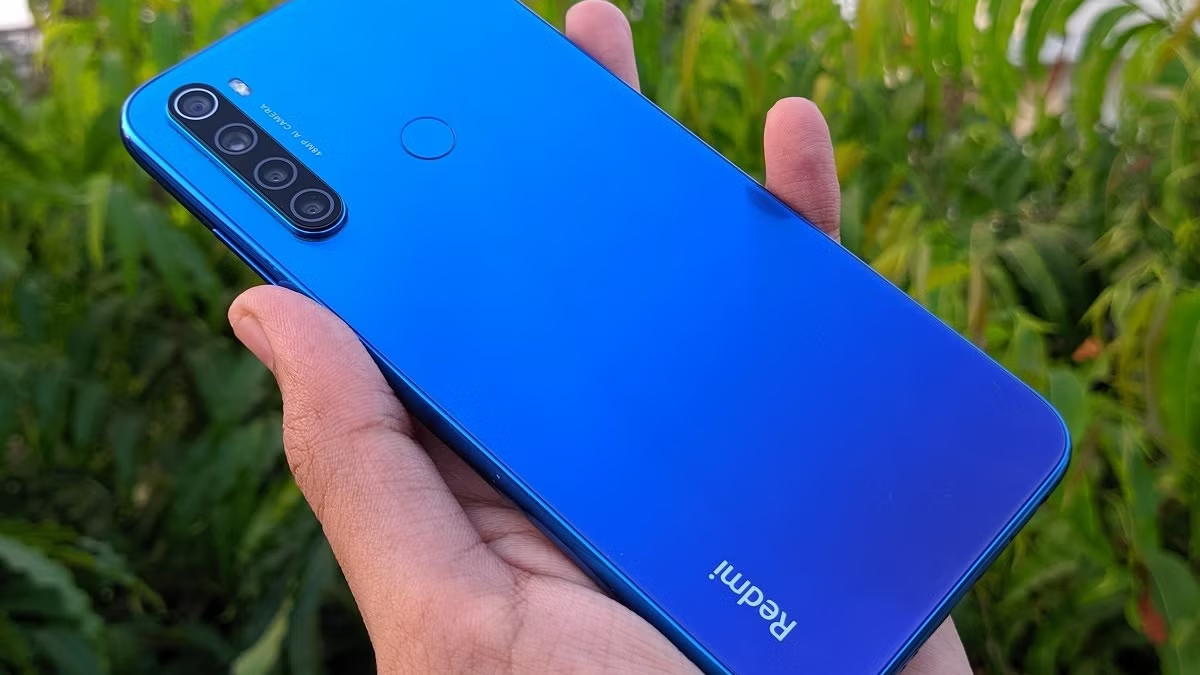
XIAOMI Redmi Note 8 stands as one of the most influential midrange smartphones ever released by Xiaomi, setting benchmarks for value, reliability, and feature balance in its category. XIAOMI Redmi Note 8 was introduced at a time when users demanded premium-like features without flagship pricing, and it delivered by combining solid performance, capable cameras, and thoughtful design decisions. From a technical writer’s perspective shaped by 25 years of evaluating consumer devices, XIAOMI Redmi Note 8 represents a carefully engineered product rather than a rushed market entry. Its success lies in how well its components work together under real-world conditions, not in headline-grabbing specifications alone. Xiaomi focused on proven technologies, conservative thermal limits, and software flexibility, allowing XIAOMI Redmi Note 8 to remain relevant well beyond its release window. Understanding this device requires looking beyond launch-day hype and examining how its hardware, software, and ergonomics support consistent daily use over time, which is where its true strength becomes evident.
XIAOMI Redmi Note 8 Design Strategy and Build Quality
The physical construction of XIAOMI Redmi Note 8 reflects Xiaomi’s pragmatic approach to durability and mass-market appeal. The device features a glass front and back protected by Gorilla Glass 5, paired with a reinforced internal frame that provides structural stability during daily handling. XIAOMI Redmi Note 8 feels reassuringly solid, with weight distribution that avoids top-heaviness despite the rear camera module. The curved back panel improves grip comfort, reducing hand fatigue during prolonged usage. Button placement is precise, offering consistent tactile feedback without wobble, while the rear-mounted fingerprint sensor is positioned naturally for quick unlocking. The camera housing is vertically aligned, minimizing lateral imbalance when placed on flat surfaces. A Senior Industrial Designer once remarked, “Durable design is invisible when done correctly, because nothing distracts the user.” That philosophy is evident in XIAOMI Redmi Note 8, which avoids unnecessary styling gimmicks in favor of functional reliability. The result is a device that feels dependable and purpose-built, qualities that significantly contribute to long-term user satisfaction.
XIAOMI Redmi Note 8 Display Quality and Visual Performance
The display of XIAOMI Redmi Note 8 is a 6.3-inch Full HD+ IPS LCD panel designed to deliver clarity, color accuracy, and energy efficiency. With a resolution of 2340 × 1080 pixels, XIAOMI Redmi Note 8 provides sharp text rendering and detailed visuals suitable for reading, streaming, and casual gaming. Color reproduction is balanced rather than oversaturated, which helps maintain consistency across different lighting environments. Brightness levels are sufficient for outdoor use, although direct sunlight may require manual adjustment. The teardrop notch minimizes intrusion while preserving structural integrity at the top of the panel. From a technical standpoint, IPS technology ensures stable viewing angles, making XIAOMI Redmi Note 8 practical for shared viewing scenarios. Rather than pursuing experimental display features, Xiaomi focused on reliability and calibration stability. This decision aligns with the overall product philosophy, ensuring the display remains consistent over time without excessive power draw or degradation, which is critical for long-term ownership in the midrange segment.
XIAOMI Redmi Note 8 Performance Architecture and System Stability
At the heart of XIAOMI Redmi Note 8 lies the Qualcomm Snapdragon 665 processor, a chipset designed for efficiency and sustained performance rather than peak computational output. Built on an 11 nm process, the Snapdragon 665 enables XIAOMI Redmi Note 8 to handle everyday tasks such as multitasking, browsing, navigation, and media consumption with dependable responsiveness. The Adreno GPU supports casual gaming without excessive thermal buildup, maintaining stable frame rates during extended sessions. MIUI optimization plays a crucial role in system stability, managing background processes and memory allocation effectively. With RAM options up to 4 GB, XIAOMI Redmi Note 8 balances cost and usability. As a Mobile Systems Engineer once stated, “Consistency over time is the real measure of performance.” XIAOMI Redmi Note 8 embodies this principle by delivering predictable behavior under sustained workloads, avoiding aggressive clock boosting that could compromise thermal performance or battery longevity.
XIAOMI Redmi Note 8 Battery Endurance and Charging Characteristics
Battery performance is a key strength of XIAOMI Redmi Note 8, supported by a 4000 mAh battery optimized for efficiency. Under mixed-use conditions, XIAOMI Redmi Note 8 reliably lasts a full day, with moderate users often extending into a second day. Power efficiency is enhanced by the Snapdragon chipset and MIUI’s adaptive background management. The device supports 18W fast charging via USB-C, offering reasonable recharge times without excessive heat generation. While not class-leading by modern standards, this charging approach supports long-term battery health, aligning with Xiaomi’s emphasis on durability and sustained usability.
XIAOMI Redmi Note 8 Core Technical Specifications Table
XIAOMI Redmi Note 8 Key Specifications
| Component | Specification | Units |
|---|---|---|
| Display Size | 6.3 | Inches |
| Processor | Snapdragon 665 | SoC |
| Battery Capacity | 4000 | mAh |
| Main Rear Camera | 48 | MP |
XIAOMI Redmi Note 8 Camera System and Imaging Performance
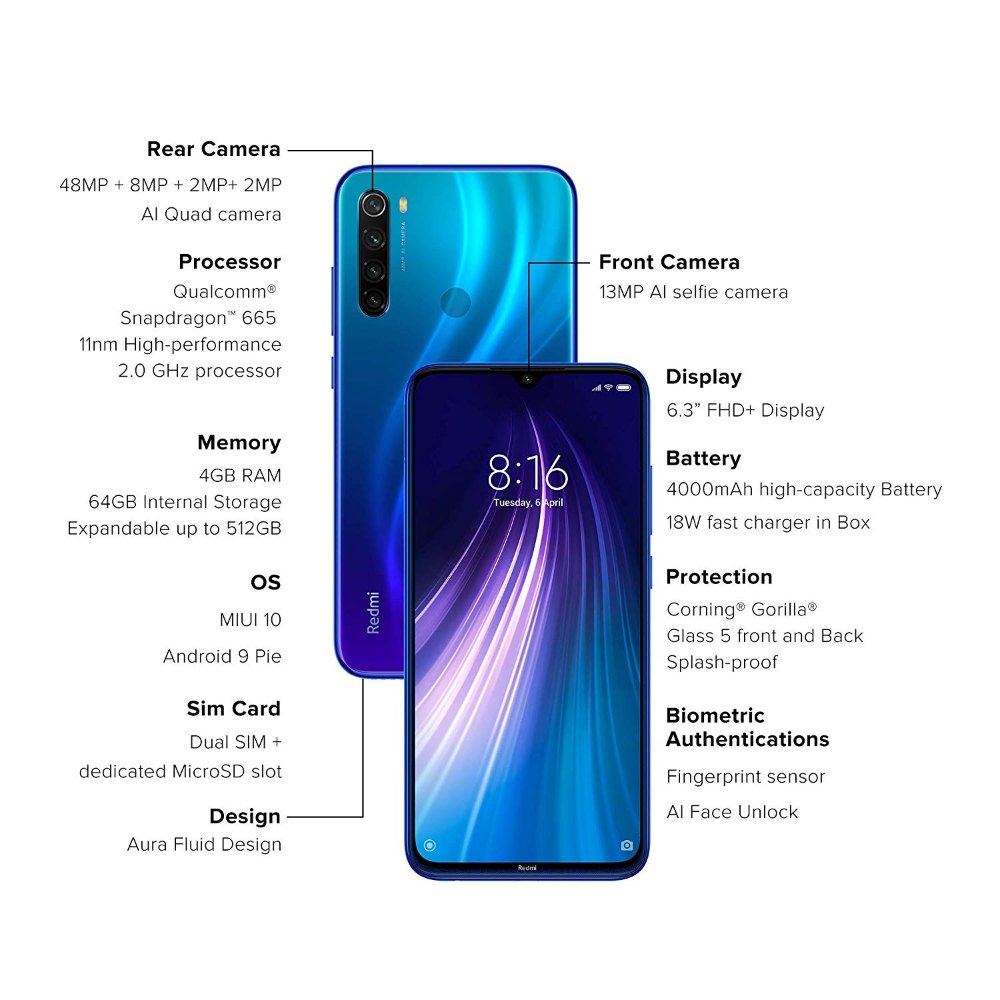
The camera system on XIAOMI Redmi Note 8 was ambitious for its segment, featuring a quad-camera setup designed to cover diverse shooting scenarios. The configuration includes a 48 MP main sensor, an 8 MP ultra-wide lens, a 2 MP macro camera, and a 2 MP depth sensor. In daylight conditions, XIAOMI Redmi Note 8 captures images with strong detail and accurate color balance. Dynamic range is respectable, particularly with HDR enabled. The ultra-wide lens expands compositional flexibility, while the macro camera allows close-up shots with acceptable clarity. Low-light performance benefits from Night Mode, which improves exposure through multi-frame processing, though noise reduction remains conservative. Video recording supports stabilized footage suitable for casual use. XIAOMI Redmi Note 8 does not attempt to rival flagship camera systems, but it delivers reliable results that meet everyday photography needs, reinforcing its reputation as a well-rounded midrange device.
XIAOMI Redmi Note 8 User Experience Strengths and Limitations
The overall user experience of XIAOMI Redmi Note 8 is defined by thoughtful compromises that emphasize value and dependability. Key advantages include:
- Durable glass construction with solid internal framing
- Consistent battery life suitable for daily use
- Reliable performance for routine tasks and media consumption
However, users should also consider certain limitations:
- IPS display lacks the contrast of AMOLED panels
- Gaming performance is limited for graphically intensive titles
- MIUI includes preinstalled applications that may require customization
These factors reflect deliberate engineering decisions rather than oversights. XIAOMI Redmi Note 8 was positioned to deliver maximum practicality at its price point, focusing on long-term satisfaction over short-term appeal.
XIAOMI Redmi Note 8 Final Verdict and Long-Term Value
In conclusion, XIAOMI Redmi Note 8 remains a landmark midrange smartphone that demonstrates how balanced engineering can deliver lasting value. XIAOMI Redmi Note 8 combines dependable performance, solid build quality, and versatile cameras into a cohesive package that continues to serve users effectively. For those seeking a proven, reliable smartphone with enduring usability, XIAOMI Redmi Note 8 stands as a testament to thoughtful product design and practical engineering.

Leave a Reply